
When choosing a sign frame, size and function are only part of the decision.
The structure of the frame also affects the final appearance.
Even small details around the edges can change how a sign feels within a space.
You can choose a version with two aluminum profiles and end caps, or a frame built with four aluminum profiles.
Both belong to the same Sharp family and maintain its slim, clean appearance. You can explore the full Vista Sharp Family to see the available sign types, sizes, and configurations.
However, each style creates a slightly different finished look, giving sign professionals another way to match the frame to the project.
So, what is the difference between the two styles?
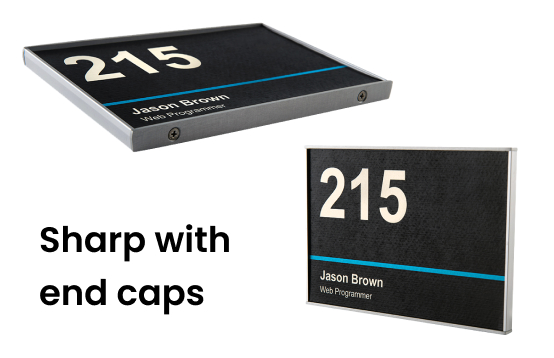
The first option uses two aluminum profiles together with two end caps.
Since it uses fewer aluminum profiles than the 4-profile version, it achieves the Sharp look with less aluminum.
Using fewer profiles can also slightly reduce the cost of the frame, making this version a practical option for different projects.
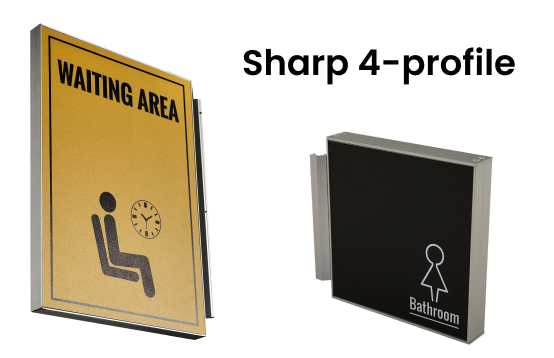
For an even more minimal look, there is the 4-profile style.
Here, aluminum profiles run along all four sides of the sign instead of using separate end caps.
The profiles create a continuous perimeter around the graphic, with fewer separate elements visible.
The result maintains the slim character that defines Sharp while creating a different finished appearance.
Neither construction changes what makes the family recognizable.
Instead, the two options give you different ways to achieve the Sharp look.
Some interiors may work better with the 2-profile structure, while others benefit from the minimal appearance of four profiles.
Having both options gives sign professionals another design choice when matching the signage to the overall project.
The flexibility of Sharp also extends beyond the frame structure.
The family can be used for wall signs, directional signs, projecting signs, suspended signs, and other configurations.
A project may require wall signs in one area, directional signs throughout the space, and projecting signs in another.
The sign types and functions may change, while the Sharp design language remains consistent throughout the project.
The flexibility goes beyond choosing between two frame styles.
Sharp graphic inserts can be removed and replaced, allowing displayed information to change while keeping the frame in use.
The system can work with paper inserts as well as rigid graphic substrates such as Di-Bond.
This combination of design choice and modularity gives sign professionals room to adapt Sharp around different project requirements.
We can also see that flexibility across real signage projects.
Vista Sharp has been used in different environments, applications, and sign types while maintaining the character of the family.
In our Project Spotlight, you can explore Vista System solutions in completed projects and see how different configurations work within real spaces.
These examples can also help show how one signage family can continue across several applications within the same project.
Ultimately, choosing between the two Sharp styles is not about finding one option that is better than the other.
It is about having the freedom to choose the structure that works best for the project in front of you.
Two profiles with end caps create one option, while four profiles create another.
Different structures, different finished looks, and the same Vista Sharp family behind both.